Showing posts with label leadership. Show all posts

10.03.2007

What's new stuff to think about?

Stuff that came up for classes:

1. Classmate said libraries shouldn't try new things. Response by me:

" Libraries still matter and how they embrace change really matters. There is a whole host of research coming about the "library as place" as an "information commons" as a "social/cultural/civic/media center for community" as a "culture of participation" -it's an exciting time for libraries that realize the needs are many, the places few, and the reason to change (and change quickly) is to remain relevant. Many cities, counties, universities and colleges have closed the doors and gutted a part of their soul: the library, for libraries were seen as useless, dusty stacks taking up a square foot of space (any true administrator thinks in cost per square foot and how to maximize this.) Libraries must find new ways to add value. The one great thing about libraries is that they can change -while still meeting current needs."
only in a european library -maybe in NYPL
2. In Europe, they showcase the Devil's Bible. Here we ban books and consider a folk tale book obscene. Fortunately, they're are some sane people in the town who actually recommend reading banned books. Read some more thoughts on it.
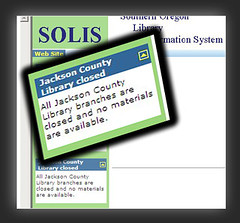
closed
3. Leadership is about preventing things that should not happen. While it's a leap and I don't know all the facts and yes I'm getting into the game late but how is it that we do not have a network that any library or library system can tap into for emergency help?

Far-fetched? Let met tell about this place that gives you things for free allowing you to get rich and even when you return them, you're still richer. Crazy right? What kind of world are we living when we let a little piece of ourselves die quietly? Where's the net to catch the weak; where are the strong and passionate to rally round the fallen, where was I when the last book drop was locked?
WoS Scopus Google Scholar
4. Oh how I love to teach the lazy, the I don't care the too--busy researcher and the deeply thorough researcher about ways to mine citation data. I also like to learn myself about the accuracy and efficiency of WoS, Google Scholar, and Scopus.
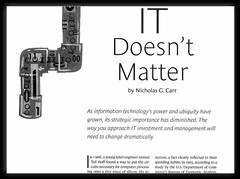
Carr 2003 IT Doesn't Matter
5. IT don't matter! or does it for libraries? Next up, the greatest use libraries can make of technology is the strategic use of IT. Don't just buy more "Internet terminals" rather make technology your b....[deletes derogatory word]...most beneficial tool.


6.13.2007

Is Wikipedia good enough?


can this be for real-1
Originally uploaded by iblee....

Recognizing that Wikipedia is "good enough" for the average user/patron/person/student/doctor/etc, stands as the most important point so-called information experts fail to accept. What!? How can we change this? We can't.

Why be so harsh on information experts?
i. Telling people you "know" what information holds the most truth is arrogant -and nearly impossible. While at times information can be verified, a solid open course of teaching information evaluation is better.

ii. We presume to tell people we know better than they do. Rather, we have just a few more years of driving on the open road that teaches us to be more cautious if even some of us learn that. We should teach healthy skepticism, coach, mentor, guide, lead when needed, . We should say: perhaps, consider other sources, look deeper, maybe, go further, don't take at face value, evaluate the legitimacy of everything, above all don't consume information like you're at McDonald's.

iii. Our new role is found working with people as the whole is smarter than the parts.

"How long long have you been driving? Are you an expert just because you've been driving a long time?"

What do most people do with information?
A. Most people don't evaluate information on the quality of the resource.
B. Most people evaluate information on its 1) usefulness to their immediate need in answering a question, 2) their desire to pursue their question further, 3) a decision-making framework based on prior knowledge, experience, and information.
C. Most people would listen to us if we first listened to them.
D. Really, we have a classic example here: librarians didn't create Google or wikipedia or ... and I think that burns most of the traditional information professionals;

Me, I'm informationally promiscuous & I represent how people pull together information for their needs. I will aggregate information as I go, fact-checking as I go, modifying as I go; I go deeper than some people -yes. Do others go deeper down into information trails than I do -yes.

Simply put, so much information is blindly accepted because:
1. we're too busy arguing on how important libraries & librarians are
2. we're too busy arguing the deeply hidden and arcane rules of OPACS, MARC, making research guides etc., --rather than illustrating Google scholar.
3. we're too busy responding to inaccurate observations. :)
4. we fail to accept the enormous hidden pressures people are under: lack of time, lack of care, lack of fluency...

Lesson:
Meredith's right. Think more like a person trying to get information, less like a guardian of the right information.

Rule:
Be steadfast by remaining open to changing your original belief as you evaluate the information you find. No text is infallible, not even the bible and the world is not flat.

Finally:
Anything taken out of context can be transformed.


5.12.2007

How do you learn 2.0?


How do you learn 2.0?
My man wasn't joking when he said "know thyself." So, know more about how you learn. Thanks jennimi.