What's going on?
3 weeks until school is done. For this year at least.

Often the way we share information is about so much more than information. Trite as it may be, it only gets better; even at the worst time, like an IRS audit. Now, to become a millionaire. lmao.
On another note, speaking of information:
"Inspired by a recording of an IBM mainframe computer which Jóhann’s father, Jóhann Gunnarsson, made on a reel-to-reel tape machine more than 30 years ago... incorporated electronics alongside those original tape recordings of the singing computer."
http://www.ausersmanual.com/
Yes. Yes, it is worth it. And for the record I love made up words.
" iblee, people make mistakes. I once spelled Katie Couric's name wrong on my blog and the very same day a college library I applied to was checking me out (I saw in my stats). I still got the interview.
This is one of the things I am often talking about with blogging. We do it, most of us, for free and on our own (meaning no paid editors). We blog because we love what we do and can't wait to share our thoughts and experiences, and in many ways our readers and fellow bloggers are also our peer review and editor. We must be gentle with one another (a friend of mine gently commented with the correct Couric spelling. Ironically, the post was about a Frontline episode addressing the threat of blogs to the traditional newspapers).
At work it's similar. If we have the luxury of working at a library that supports this kind of thing, maybe we have colleagues and committees and teams to work on projects - checking each others' work and giving constructive feedback. But not all of us do and as librarians I hope we can be gentle in finding error. Personally, I want that same kind of treatment in return. I want folks to give me some latitude on a bad day, as I would give them. So I spelled something wrong. End of world?
But anyway... there are bigger things in life than an extra apostrophe. There are a few common mistakes that Word and others just never catch. The beauty of the fact that I am not a robot is just that: I am human. Flesh and bone, mistakes and all. Fragile and strong. And while I may not get everything right all the time, I am passionate about it, and I do it with style. I'll take a flawed poster encouraging students over a nit-picky snarkment any day. And don't get me started on a few of my readers who can't stand my made up words.....
The subject of language as a living breathing evolving organ can be a whole other essay. I've apostrophied on way too long here. :)"
Well said jennimi. I found your comment: prescient and humble. Or preshumblent -for the record, that's my made up word. It means humble while sharing the ability to see things unfold in the future. Like our own future mistakes.
Its :P right on.
What's funny is that I had read this before I chose to start posting mistakes, warts, guffaws, errors, idiocies, bleeps, and all.
Rather than make sure my blog entries are perfect, pictures are perfect, code is perfect, grammar is perfect -I thought: why not just push to get more stuff out of my head and up on the web --share my thoughts --push my creative limits-- be less worried about getting it right and be more worried about getting it done.
"Below average" as a writer accurately describes my writing abilities. I only wrote my first paper (shudder when I call it that) in 1996. Yes, 1996. While 11 years have passed, consistent writing still escapes me. To feel I mastered what I should have learned from grade school & high school in the same time I'm supposed to be writing at the graduate level is a joke --on myself. I'm still learning some basics now.
While I write "for" the graduate level and do a pretty good job, most times it is an arduous struggle to produce a work I am proud of. I had not wrote a single paper in high school, did very little in depth writing in the military (mostly short, bulleted, tech reports.) In fact, the very first paper I wrote in college was, ...hold your breath... 3 pages! And I got a "C" on that paper.
Now it's years later and I realize I'm missing critical writing skills. But, I am slowly picking them up. Being years behind in the basics doesn't make it easy. Working hard to develop my writing I feel the thoughts/ideas in my head & the words I see don't even come close to articulating what I want to say. Then I make mistakes -oh that's just great.
Now you add the horror of people thinking you are less intelligent +your mistakes +lack of ability to articulate +desire to produce thought provoking quality writing +the fact that you don't know most people go through or have gone thru this process and it = performance anxiety, that is, until you face it. The research on reading & writing prove this true.
It's just funny that the week I push myself to experiment more, I get vociferous feedback, indirectly, on a minor mistake. (I shared it for comments to be sure.) Here I am trying: to publish more of my work, to grow professionally, to challenge myself by exposing more of my raw creative process. I post something and the first thing people do, while compliment it, is criticize it. Seems backhanded. I like being criticized; as long as I know it's coming. I'm not opposed to it at all and produce my best work, usually, only after someone totally shreds it.
When you think it's such a horrible error why not contact me directly like one poster on my flickr account did. I found that admirable. And indirect comments show that we have a tendency to do one thing first: find fault. I'm not crying over it. I'm not hurt or sad or remiss. Actually, it's emboldening. I'm quite distant from the happenings & only know about it indirectly.
What I am doing is using this as a writing exercise. There are a lot of reasons but this helps. Sorry if you can't handle a wide swatch of language but: don't stomp on me because you are living in fear. I gave that up a long time ago. I wish to bring civility back, because it's not about the cell phone. I would like to see courtesy, respect, and dialogue, not discussion, rise.
Any and all mistakes are my own.
can this be for real-1
Originally uploaded by iblee....
Recognizing that Wikipedia is "good enough" for the average user/patron/person/student/doctor/etc, stands as the most important point so-called information experts fail to accept. What!? How can we change this? We can't.
Why be so harsh on information experts?
i. Telling people you "know" what information holds the most truth is arrogant -and nearly impossible. While at times information can be verified, a solid open course of teaching information evaluation is better.
ii. We presume to tell people we know better than they do. Rather, we have just a few more years of driving on the open road that teaches us to be more cautious if even some of us learn that. We should teach healthy skepticism, coach, mentor, guide, lead when needed, . We should say: perhaps, consider other sources, look deeper, maybe, go further, don't take at face value, evaluate the legitimacy of everything, above all don't consume information like you're at McDonald's.
iii. Our new role is found working with people as the whole is smarter than the parts.
"How long long have you been driving? Are you an expert just because you've been driving a long time?"
What do most people do with information?
A. Most people don't evaluate information on the quality of the resource.
B. Most people evaluate information on its 1) usefulness to their immediate need in answering a question, 2) their desire to pursue their question further, 3) a decision-making framework based on prior knowledge, experience, and information.
C. Most people would listen to us if we first listened to them.
D. Really, we have a classic example here: librarians didn't create Google or wikipedia or ... and I think that burns most of the traditional information professionals;
Me, I'm informationally promiscuous & I represent how people pull together information for their needs. I will aggregate information as I go, fact-checking as I go, modifying as I go; I go deeper than some people -yes. Do others go deeper down into information trails than I do -yes.
Simply put, so much information is blindly accepted because:
1. we're too busy arguing on how important libraries & librarians are
2. we're too busy arguing the deeply hidden and arcane rules of OPACS, MARC, making research guides etc., --rather than illustrating Google scholar.
3. we're too busy responding to inaccurate observations. :)
4. we fail to accept the enormous hidden pressures people are under: lack of time, lack of care, lack of fluency...
Lesson:
Meredith's right. Think more like a person trying to get information, less like a guardian of the right information.
Rule:
Be steadfast by remaining open to changing your original belief as you evaluate the information you find. No text is infallible, not even the bible and the world is not flat.
Finally:
Anything taken out of context can be transformed.
Why not think more like a patron
Originally uploaded by iblee....
Why did I never hear from the ILL department?
3 months later: In under one week, I obtained this article from another ILL department.
How many patrons are that persistent? How many have been silently frustrated? Why can't we anticipate or adumbrate or predict our patrons' desires? Why do empathize so little with our patrons’ information needs? Why not think more like a patron and less like a librarian? There are ways we can get peoples' information attention -since we have both skill sets: librarian & patron we should be able to meet their needs before they know they have a need.
Why do we force patrons to think like us? When we hate that very thing in other organizations, like the DMV, Health care, Banking?
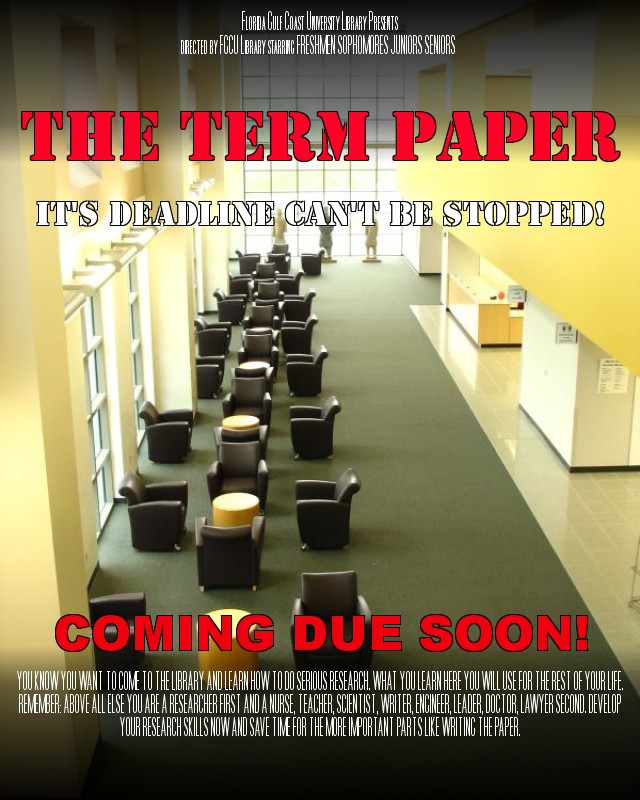
Students want a library
Originally uploaded by iblee....
Your entry is meant to be informative about the Library in general. I bet your library has awesome resources, great people working there (Hmm, imagining an entry on the actual personalities now ), and a rich history. Portray your unique history -even if it's not deep or long or ivy- the curious or casual browser may become enamored with what they learn about the library; they may learn that libraries are these fascinating places where bytes and bricks can meet. You never know when you are going to bring the library into someone's life.
I would bet money that schools and therefore other parts of a school do get looked up on Wikipedia. Since we are one of the items students consider when selecting a school maintaining presence makes sense.
"On students' must-see list during college visits were buildings housing their major, said 56.8 percent of respondents. Rounding out the top five were residence halls at 53.1 percent, the library at 48.4 percent, classrooms at 46 percent, and technology facilities at 40 percent."
http://chronicle.com/weekly /v52/i40/40a02701.htm
Above all else: avoid library-speak in your entry. Make it human-readable.
Where do you go for context?
http://www.shorpy.com/
Thanks for the link Matt. We do have it pretty darn good.